
 by admin
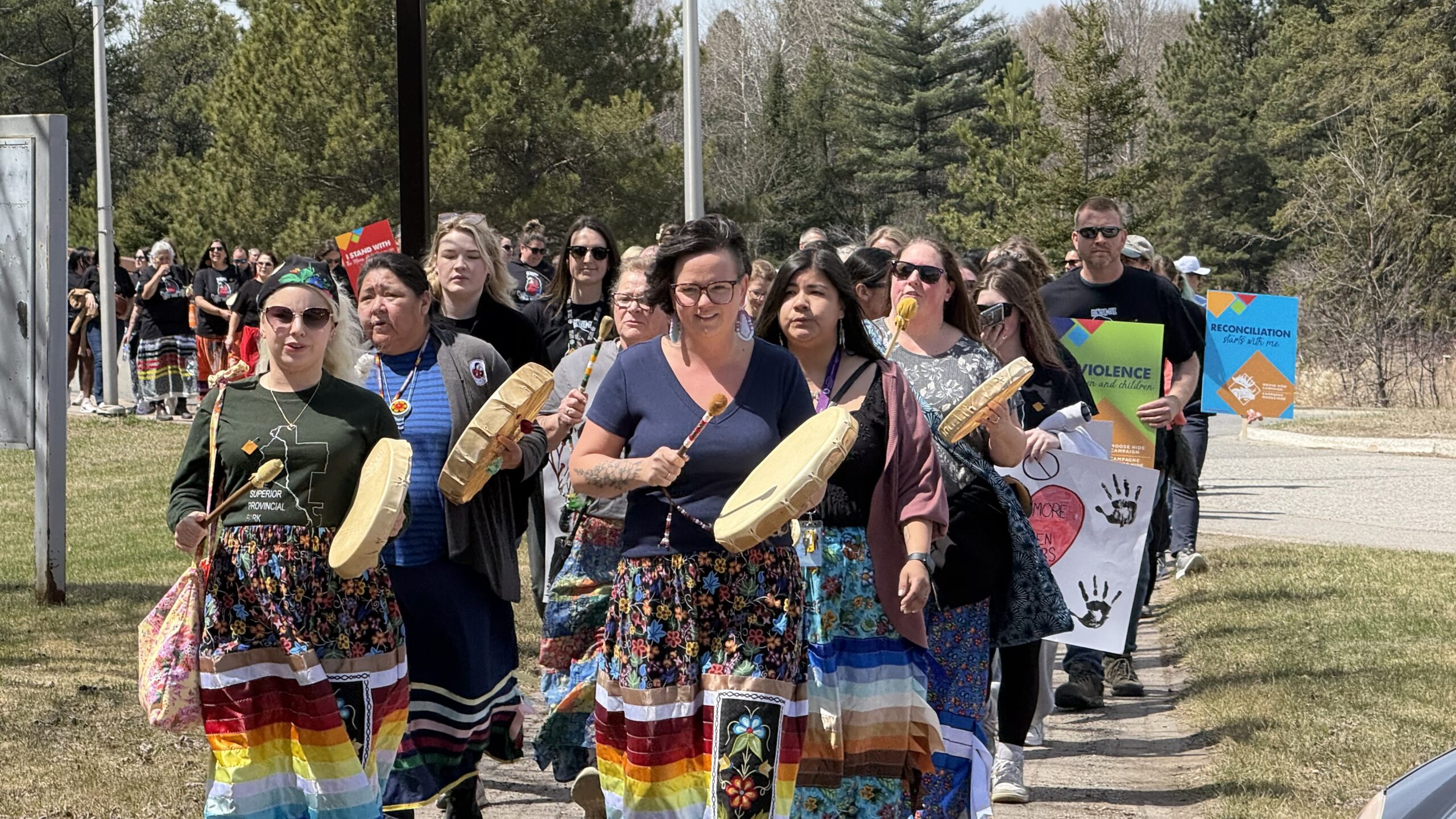
Indigenous leaders, community members, and organizations came together on Thursday for the Walk to End Violence.
Participants walked from Lakehead University to Confederation College, congregating at the college’s outdoor amphitheatre to make their voices heard.
The walk was organized as part of the Moose Hide Campaign, which draws attention to violence inflicted against Indigenous women and girls.
It broadly addresses the subject, making space to advocate both for missing and murdered Indigenous women and girls (MMIWG), as well as against domestic violence within and outside of Indigenous communities.
Notably, the Moose Hide Campaign places special attention on Indigenous men and boys, whom it calls upon to take action against and accountability for gender-based violence alongside the women and girls of their communities.
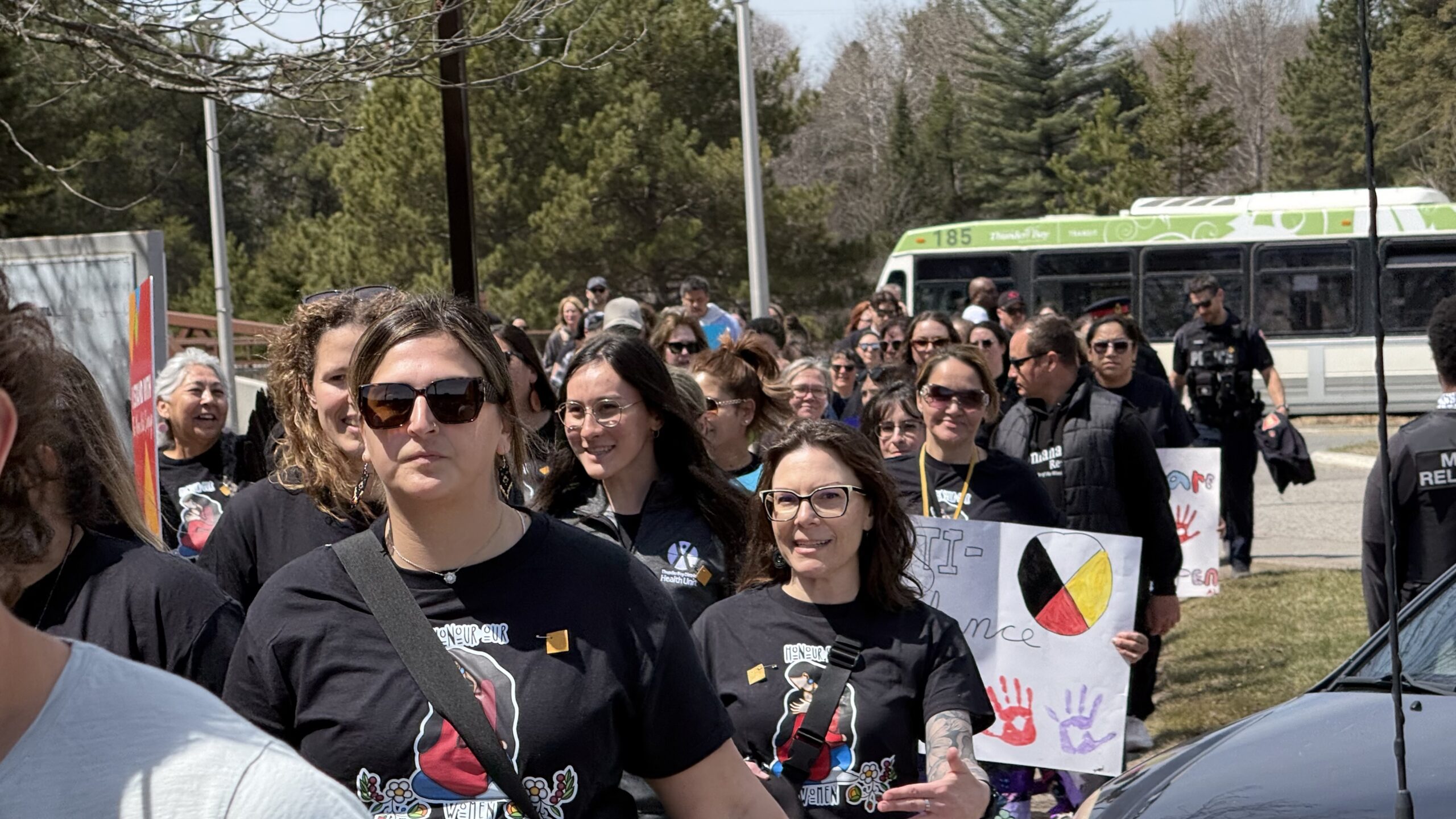
“This is not just a woman’s issue,” says CEO Cora McGuire-Cyrette of the Ontario Native Women’s Association (ONWA), who participated in the walk. “There’s a role and a responsibility for men to play in addressing violence against us.”
After the walk, participants listened to speeches from both male and female Indigenous community leaders: space was given to share in the grief of those who have lost loved ones to gender-based violence, and to contextualize the ongoing healing process in Indigenous communities that is so essential to preventing it from continuing.
As the Moose Hide Campaign points out, Indigenous women are killed at six times the rate of non-Indigenous women in Canada.
But gender-based violence is not simply a problem of non-Indigenous individuals harming members of Indigenous communities: Indigenous women face spousal violence at three times the rate of non-Indigenous women.
McGuire-Cyrette says the special onus placed on men and boys through the Moose Hide Campaign is to “stand up against violence if they’re seeing it online, if they’re seeing it happen in public, and to not be that silent witness, but to be that voice saying ‘no more’ and that Indigenous women are sacred.”
She hopes that men can “walk this journey with us — not in front of us, or behind us, but with us.”
The gathering at Confederation College was accompanied by music from the Charging Thunder Singerz, a male youth group of Indigenous singers and drummers, whose presence demonstrated a way forward for Indigenous men and boys through maintaining the cultural and spiritual practices of their forebears.
McGuire-Cyrette says the presence of Indigenous-led and centred campaigns such as the Moose Hide Campaign has a powerful healing effect on Indigenous folk.
“Men and women have come up to me after these events and have thanked me, because they had finally, for the first time, felt like their voice was heard. And then they go home, and they start to do their own healing, which is exactly what we want to see,” she explains.
The healing process McGuire-Cyrette refers to is linked to cultural and spiritual practice.
She says events like the Moose Hide Campaign have inspired Indigenous communities to do their own cultural and community programming, such as healing circles.
“We’re seeing youth coordinate together to pick up their culture and be proud to be Indigenous,” she remarks.
McGuire-Cyrette thinks community-led events are particularly important because government support for Indigenous issues is often unreliable.
She draws attention to a lack of funding for many of the Calls for Justice that were laid out in the National Inquiry into Missing and Murdered Indigenous Women and Girls, arguing that the federal and provincial governments are more concerned with the aftermath of violence, rather than preventing it.
“We see investments into the policing system. We’re seeing investments for Indigenous women to be housed in prison systems… These are not the investments we’re calling for,” she states, noting that Indigenous women make up about half of the female prison population in federal prisons, despite making up only five per cent of the population.
“We’re calling for investments into our education, into healing programs, into the shelter systems, like everything that is in the National Inquiry to be acted upon,” McGurie-Cyrette adds.
The ONWA CEO is glad to see a growing number of participants in the Moose Hide Campaign every year, and hopes to see community-led pressures to drive change continue.
“We have to recognize that it’s not only on politically elected people to do this work,” she says. “It’s up to us as community members to be able to make this change. And what that change looks like is us being kind to one another, whether you’re Indigenous or non-Indigenous. It looks like us being in relationship once again.”