
 by admin
Long after her grandmother’s home in Dryden had fallen quiet, Sophia Bartholomew found herself returning to thousands of photographs: deer in the yard, snowbanks, flowers, birds gathered outside the house, cakes, shadows cast across windows, trees and lakes.
Not milestone moments. Not birthdays or weddings. Just fragments of ordinary life.
As Bartholomew sorted through albums and shoeboxes while helping care for her grandmother in the final years of her life, she became increasingly drawn to those quieter images, the kinds of moments most people overlook, but which ultimately make up the texture of living itself.
“The place where life really happens is in between these visible ‘significant’ moments,” she says. “Cooking, eating, sleeping, waiting, bathing, talking, grocery shopping, doing laundry, driving, staring out the window.”
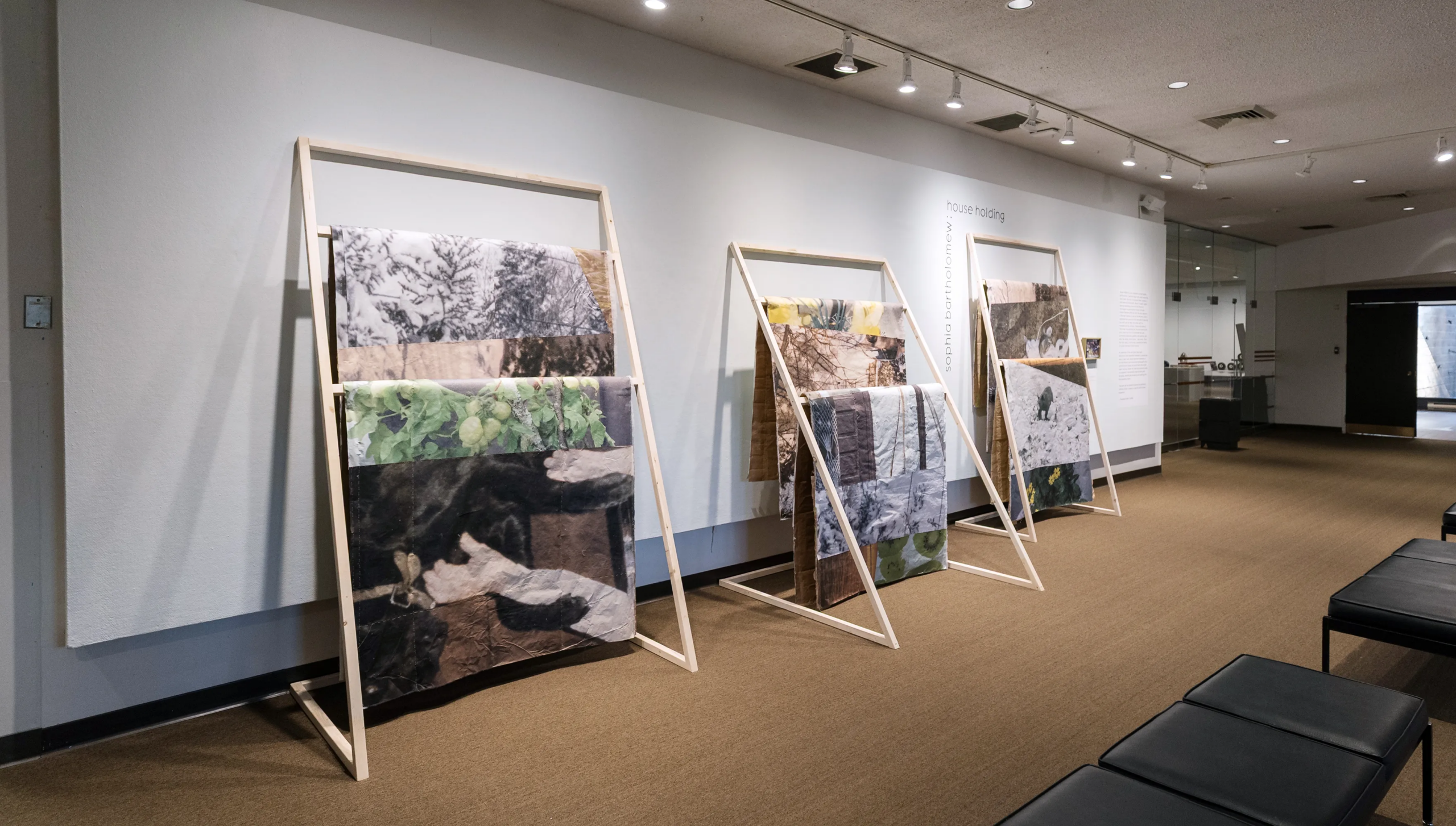
Those fragments now form the foundation of house holding, Bartholomew’s exhibition at the Thunder Bay Art Gallery, an installation exploring memory, caregiving, domestic labour, fragility, and the invisible work that quietly holds lives and homes together.
The exhibition centres around six large-scale quilt-like works constructed from enlarged photographs printed on translucent architectural plotter paper, layered with batting, quilting thread, and flattened paper bags. Each piece measures 4’ by 8’ feet (the dimensions of drywall or plywood sheets) and hangs from wooden structures resembling quilt racks, leaning against the gallery walls.
At once delicate and structural, the works feel suspended somewhere between construction site and family home.
“I was imagining they might be part of the construction of a home,” Bartholomew says. “A soft layer that covers all of the walls and makes the space livable.”
That tension between fragility and structure runs throughout both the exhibition and Bartholomew’s artistic practice. Bartholomew describes herself as a mid-career artist whose work spans drawing, sculpture, photography, installation, writing, video, and collaborative practice, often incorporating salvaged or repurposed materials.
She traces part of that material language back to her time in Dryden and the rural property where her grandmother lived. Her grandparents operated a construction company out of their home for decades, and construction materials became embedded in the rhythms of family life.
“I’ve come to incorporate construction-grade materials like plaster, poly-tarp, nylon rope, chicken wire, zip ties, dimensional lumber, and protective floor paper into my work,” she says, often pairing them with salvaged bedsheets, scrap lumber, paper, wire, and household waste.
The approach reflects what she describes as a kind of inherited resourcefulness — one shaped by both rural life and the habits passed down through generations of women in her family: saving, sorting, repairing, remaking.
“In particular, the time that I spent living with my mother’s mother on a rural property in Dryden helped me understand the material logic of my work,” she says.
That understanding deepened further after surviving a near-death accident in her late teens, an experience she says profoundly shaped her relationship to fragility, impermanence, and interconnectedness, themes that continue to resurface throughout her work.
“I always seem to circle back to notions of movement, porosity, fracture, impermanence, entanglement, and interconnection,” she says.
Those ideas become especially resonant in house holding, where photographs are fragmented, enlarged, cut apart, and stitched back together into sprawling patchwork surfaces. Rather than preserving memory as something fixed or complete, the work embraces its instability.
“One of my mentors described my work as a ‘past-future conduit,’” Bartholomew says. “Working with materials from the near and distant past and connecting them to my lived experience of the present, as a way to imagine new ways forward.”
Time, in her work, is rarely linear. Past, present, and future collapse into one another through layers of paper, stitching, repetition, and repair.
“I think the raw material of our lived experiences is quite fragmentary,” she says. “Part of what we do in our day-to-day lives is the work of making it all make sense — stitching together a story of ourselves, our lives, the world.”
That language of patchwork and reconstruction extends beyond personal memory into broader questions about what society chooses to value and document. Bartholomew says modern life often elevates visible milestones while overlooking the quieter labour and repetitive acts that actually sustain human existence.
“Work that’s done in the home continues to be a form of work that is erased and undervalued,” she says. “This includes practical tasks like cooking and cleaning, but also the mental and emotional labour required to run a household.”
By enlarging photographs of seemingly uneventful moments — snowfalls, trees, animals, kitchens — and reconstructing them into monumental forms, she hopes to create what curator Penelope Smart describes as a “drive towards proof of life.”
“How all together, pieced together as a patchwork, the photos can start to express something about the fabric of experience and memory that is undocumentable,” Bartholomew says. “Where life happens in the spaces between things.”
The process itself becomes inseparable from the work’s meaning. Sewing the pieces together by hand was slow, repetitive, and painstaking, an approach Bartholomew sees as central to the exhibition’s emotional and conceptual weight.
“Because the way that I work is slow, there’s more time for the work to figure itself out during the process,” she says. “There’s more space for me to listen to what it’s doing and to respond and adapt my approach.”
That slowness also shapes the way the exhibition asks to be experienced. From a distance, the installation reads one way; up close, details begin to emerge through layers of stitching, translucency, texture, and image fragments.
“It feels important that you can get one thing from it by looking at it from a distance,” she says, “and that you get other information when you spend time with it up close.”
Rather than reconstructing exact memories, Bartholomew says the work is trying to recover something more difficult to define.
“I’m trying to rebuild the feeling of the home that my Mormor held together,” she says, “a place that no longer exists.”
In the end, house holding becomes not just an exhibition about memory, but about the quiet acts of care, labour, repair, and attention that shape homes and lives, the kinds of experiences that rarely announce themselves as monumental, yet form the fabric of existence all the same.
The exhibition continues at the Thunder Bay Art Gallery through June 15, 2026.