
 by admin
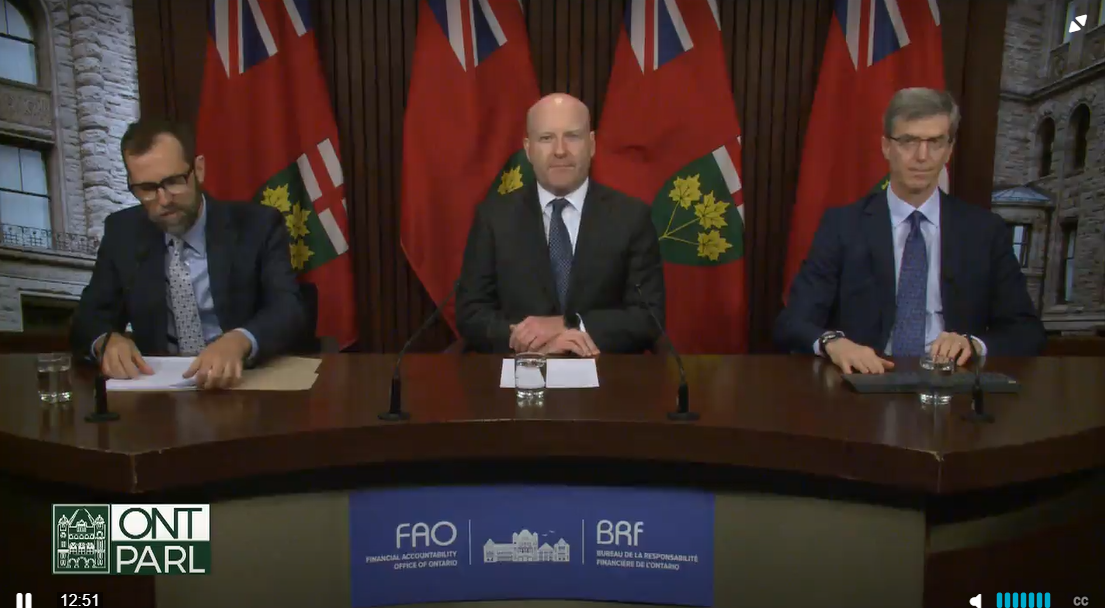
Ontario’s economy is taking a slight dip.
The Financial Accountability Office says real Gross Domestic Product (GDP), the broadest measure of economic activity, declined by 0.3% in the last three months of 2025, marking the second decrease in the past three quarters.
The FAO points to employment losses, slower housing market activity and lower manufacturing sales as the main reason
High fuel prices are also having an impact on Ontario’s economy.
The FAO says the U.S.-Iran conflict, which is impacting oil shipments from the Middle East, could cost Ontario consumers an extra $8.5 billion in gasoline and diesel fuel costs.
Financial Accountability Officer Jeffrey Novak says that works out to be about $648 per person, if the key shipping lane, the Strait of Hormuz, is reopened this month.
“If the strait does not open, it would actually be higher,” says Novak.
“We’re assuming that the strait would open in June. Oil prices will come down a little bit, but still be higher than pre-war levels.”
A population decline is also causing some concern for the provincial economy.
According to estimates from Statistics Canada, Ontario’s population fell by about 119,000 in 2025.
Novak says that is the first decline since 1951.
“That’s due to a decline in temporary residents and also a slower increase in permanent residents,” says Novak.
Employment also fell, with the province losing 52,900 jobs, the steepest quarterly job loss since early 2009, excluding the pandemic.
The FAO notes that declines were partially offset by strong gains in retail sales and wholesale trade.
Retail sales increased by 1.7%, while trade increased 2.9% over the first three months of 2026.