 by Tara Clow
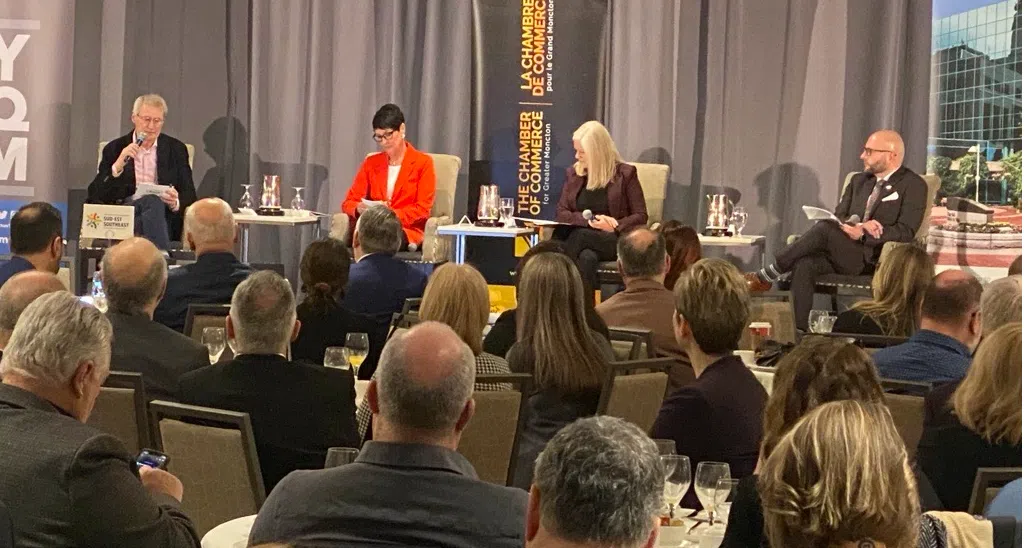
The Chamber of Commerce for Greater Moncton hosted the 2025 State of the Tri-Communities event on Tuesday morning at the Delta Beausejour.
Chamber CEO Kim Wilson asked the three Mayors questions during the event, based on a survey of Chamber members that was conducted in late 2024.
The survey asked Greater Moncton businesses to identify their biggest challenges as they head into 2025. The top answer cited by 24 per cent of respondents was finding employees with the right labour skills. The second highest response at 19 per cent was inflation and high interest rates.
Surveyed members for the communities of Moncton, Dieppe and Riverview, also identified dealing with homelessness was the clear top priority for municipal governments at 31 per cent, followed by housing at 19 per cent, and safety and security at 17 per cent.
Moncton’s mayor Dawn Arnold says investments are being made to help tackle homelessness, but they’re not sustainable.
“I was trying to think of the perfect analogy for this. The homelessness crisis is like trying to patch a sinking ship with a band-aid or duct tape, you take your pick. We keep applying quick fixes to the holes as they appear, funding temporary shelters, emergency services, and short-term programs, but the ship is still taking on water. So without addressing the underlying structural damage, like the lack of affordable housing, inadequate mental health support and systemic inequality, we will never stop it from sinking. What we need are not more band-aids, but a full overhaul of the system to keep the ship afloat and everyone safely on board,” Arnold stressed.
She also reminded everyone that social challenges are a provincial responsibility.
But Arnold adds the city has stepped up, “We spent $5.1 million last year simply on social issues in the city of Moncton. The taxpayers of Moncton paid $1.3 million in grants. This is a 700 per cent increase in 10 years. We invested in 24/7 by-law enforcement to the tune of $2.7 million which is an increase of 1.4 million since 2019. We are investing heavily in policing. Since 2021 we have increased our police budget, all of us, by 65 per cent. We have clean-up costs every year, $380,000 for our downtown cleanup program, plus another $256,000 for tent site cleanup, for vandalism, and this sort of thing. We, the taxpayers of Moncton, are paying for all of this. We invested another $300,000 into the humanity projects. Josh project.”
Arnold called on everyone to support housing in our communities, and not to be a NIMBY.
” We need housing. It is very, very clearly demonstrated. Ask your MLAs when you see them, when is a mental health court coming to Moncton. When will there be a 24/7 supervised facility for the hardest and most challenged in our community right now, or when can we expect changes to the police act? And when will we be hiring more Crown Prosecutors? Because that is the kind of change that we need in our community right now.”
She also repeated a statistic from the Canadian Medical Association Journal, “They did a deep dive on housing in May of 2024 and they discovered that in 1974, now 51 years ago, more than 20 per cent of all housing in our country was either non-market or social housing. Fast forward now 51 years, less than 4 per cent of the housing in our nation is non-market housing. To me, that goes a long way to explain what we are seeing on the streets of our city and cities across this country,” Arnold said.
Riverview Mayor Andrew Mayor Leblanc agreed, stating that there is a need for different types of housing. We’re looking to find ways to make it easier to build and develop in Riverview, to expand the housing stock available.”
Dieppe Mayor Yvon Lapierre says they are working with developers to create more housing and affordable housing units.
Thirty-eight per cent of respondents to the Chamber survey said they currently have a shortage of skilled workers and 32 per cent said they have difficulty recruiting and retaining employees.
Mayor Arnold also expressed her concern over the changing narrative surrounding immigration, “The federal government is taking a one-size-fits-all approach, “This is actually something I lose sleep over. I am very worried about the changing narrative around this, and I think we need an Atlantic Canadian approach.”
She plans to bring this issue to the Atlantic Mayor’s Congress and also has a call with the Halifax Mayor next week because she says changes to immigration policies in Canada are very worrisome for all of them.
“One in six or 17 per cent of our entire workforce is a newcomer. That’s a lot, and you see them everywhere. We also know that 130,000 people will retire out of New Brunswick or leave New Brunswick’s workforce in the next five years or so. So we don’t have a choice here. We have to be a welcoming and inclusive community,” Arnold adds.
Arnold also promoted advocacy and leadership in this regard.
“We need to step up. You need to pay competitive wages. You need to create inclusive environments. But what can you do as an individual human being? Be bold, use your voice. The reason that speaking out is so important is that it lowers the perceived risk for others. For those who are silent and have something to say, your courage matters, your words matter, and every voice is key to unlocking another so don’t put up with it. If you hear racist comments, if you hear things that are non-inclusive and don’t reflect our community. Step up, say something. And that’s how we will make our community, more inclusive.”
Education was also discussed as a priority for the three Mayors.
“We have a growing Francophone population, and those kids cannot go to school in their community right now. That needs to change, and it needs to change quickly,” stated Mayor Leblanc about the Town of Riverview.
He also spoke about the small-town feel of his community.
Leblanc says Riverview is the fifth largest community in New Brunswick, but it’s important to maintain those small-town morals, “Despite that, despite $137 million in building permit approvals, despite new diversified housing, more folks coming to town, population growth, we still have the small town feel. We still have those values, and we still have the connectivity.”
Leblanc adds one of the challenges going forward, is protecting those small-town values while seeing the fast rate of development and population growth.
All three agreed that there must be a collaboration between all levels of government, but encouraged business leaders to help in that respect.
Lapierre also says the communities can get further ahead if they all work together.
“The common theme we heard today from all three of our municipal leaders is to get involved, We all have a role to play. It’s easy to sit back and pass judgment or criticize, but we all play a role collectively in our region continuing to prosper and grow. We get further together,” Chamber President Wilson stated to wrap up the State of the Tri-Communities event.