
 by admin
Picture this: A friend, Tracey, and her son, Carson, were enjoying a vacation as they drove through Europe. They were having fun, taking in the scenery, and navigating unfamiliar roads when they found themselves in a roundabout. Entering a traffic circle was easy, but how do you get out? They said they were literally going round and round and round…
Roundabouts have been around since the 1800s, but the times and rules have changed. Today’s roundabouts are designed to improve traffic flow, reduce congestion, and significantly increase safety at busy intersections.
Here in Thunder Bay, there are people who say they have gone out of their way to avoid roundabouts, so I reached out to a friend, Neil Cochrane, who lives in Ireland, for his take. He says he sees them as a common sense solution. “If you approach a roundabout, you either move straight through or you’re waiting a short time. If it were a junction with a lights system, you’re waiting even if there are no vehicles coming from other directions. So, naturally, you could be waiting much longer. We’ve seen roads where roundabouts were replaced by traffic light systems and it slowed everything down, very frustrating. Roundabouts have a solid logic to them once you understand it. We have roundabouts with three lanes here. If your exit is before 12 o’clock, approach on the outside lane; if it’s beyond 12 o’clock, approach on the inside lane.”
When it was announced that a roundabout was in the works here, it sparked a heated debate online, with comments for and against it flooding social media. Those in favour were looking forward to not having to stop so often for lights; some had experienced them elsewhere, with no troubles. People opposed said there would be confusion, that “roundabouts are a fad”, and “Thunder Bay Drivers will never get out!” In October 2021, the roundabout opened with city workers on hand to help educate drivers on how to maneuver through it.
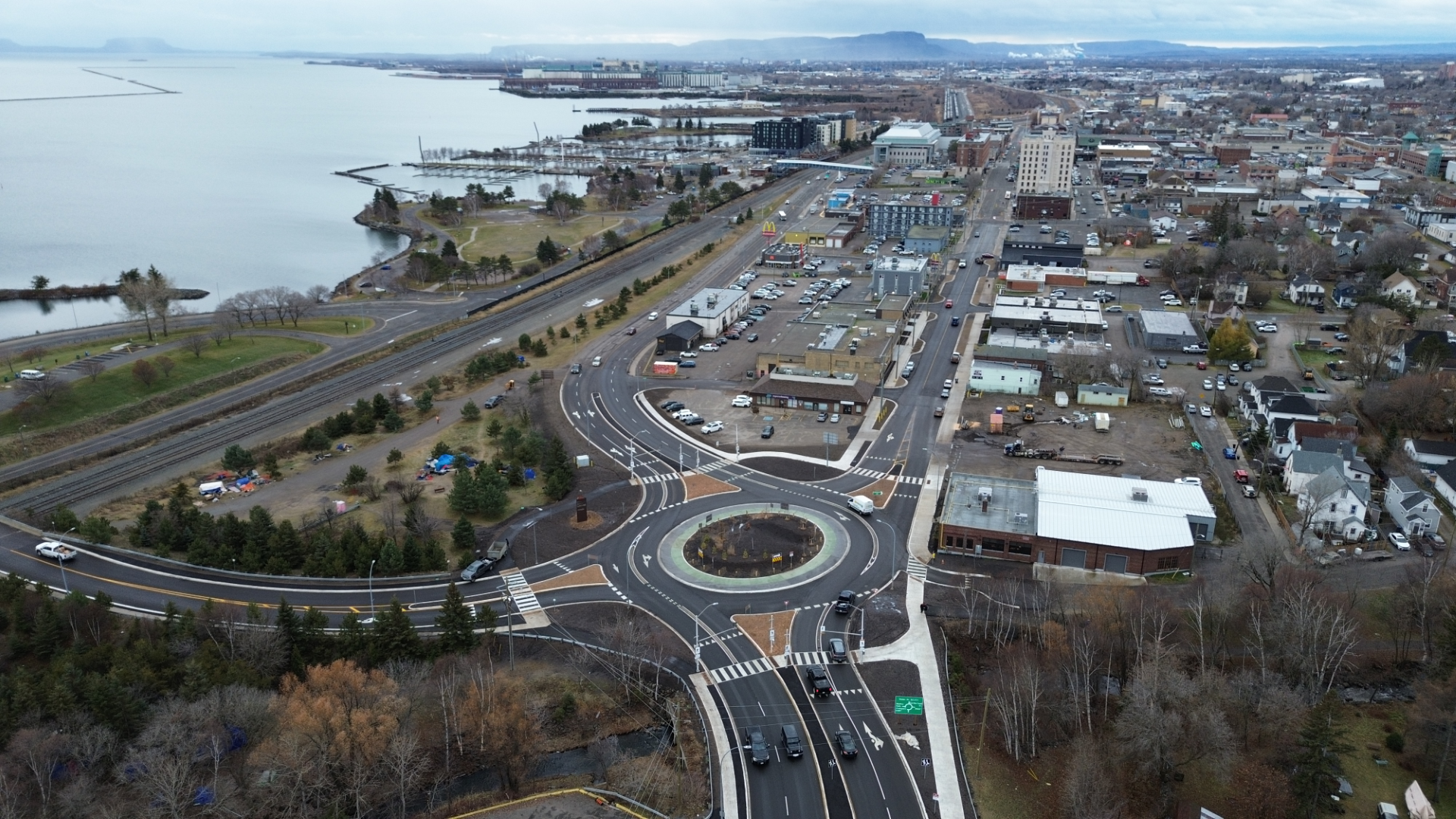
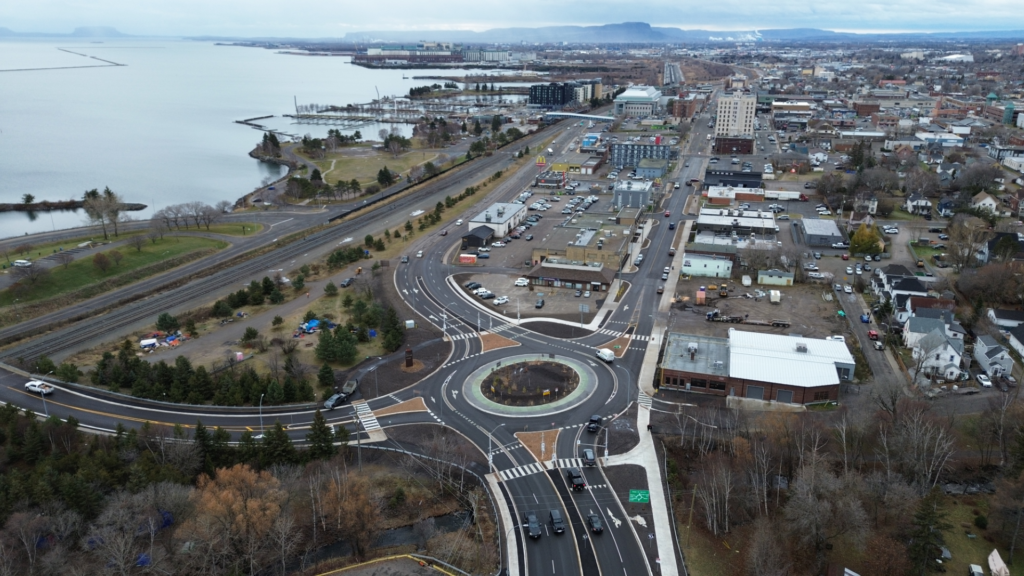
Fast forward a few years, a second roundabout at the marina overpass was being constructed. The back and forth on social media continued from people who thought the roundabouts are awful and they would cause collisions, and others saying they were happy it was being constructed as they save money on lights and there’s no stopping to wait for a light to change.
Looking for help to make roundabouts less daunting, I contacted Matthew Miedema, the city’s Director of Engineering.
Miedema says the design process for roundabouts is constantly evolving and the city keeps an eye on the latest trends. “So for Cumberland Street, what we did this time is more of a channelization. It’s kind of a mix of the traditional roundabout of current years, with the newest standard, which they call turbo roundabouts. This is what they’re doing in Europe and other places where it’s more lane controlled, because people are changing lanes inside the roundabout. When you’re in the roundabout, you’re not allowed to change lanes, you stay in your lane and follow your path through. So when we were looking at reports on collisions at the Edward Street Roundabout, changing lanes was seen as one that was too frequent. So the way to mitigate that is with lane delineators, like the ones you see in the Cumberland Street roundabout. They’re little concrete rumble strips.”
For those with concerns about potential collisions, Miedema shared a striking statistic: In a traditional intersection, there are 32 conflict points where vehicles can collide. In a roundabout, that number drops to just eight. By design, the opportunity for a crash, and the severity of one, is significantly reduced.
Miedema notes there are savings for drivers, and environmental benefits. Since you aren’t idling at a red light and roundabouts are ‘yield on entry’, you don’t stop. You just slow down, which reduces both emissions and fuel consumption.
Miedema says roundabouts will also save money for the city. Comparing the cost of construction of intersections with lights and roundabouts, he says it does cost more because you have to build that infrastructure around it with the sidewalk and reconfigure the road. “But, once you’re there, the lifecycle cost, the roundabout wins out over intersections with lights because you’re not paying for the electricity, the telecommunications, the maintenance of those signals. Traffic lights have a lot of higher maintenance standards, because they are controlling traffic and it is a public safety concern. And while you turn the traffic lights on and leave them, you still have to do constant checks and make sure they’re maintained. Anytime we can look at an intersection rebuild, we look at all options which include keeping the signals, removing the signals altogether, converting to all-way stop or the roundabout option. So all of them will be evaluated to see what’s the safest and best for traffic.”
Miedema says the caveat to the roundabout and our struggle in Thunder Bay is the property requirments. “A lot of times you need to buy property in order to construct a roundabout and that’s when it becomes cost prohibitive because that’s a big expense. You may have buildings or other things in the way that kind of limits it. So signals will win out on occasion.
The Edward / Redwood area was unique because when they planned that area in the 70’s, a roundabout was included as part of the plan.”
Yes, this roundabout has been planned for a few decades! And it seems we’ve become a bit of a trailblazer. Miedema says his colleagues in Waterloo, the city often considered the “leading edge” for roundabouts in Ontario, are actually looking to follow our lead on the new Cumberland Street design
I asked about concerns from people who are visually impaired, about crossing at roundabouts.
“For the Edward Street pedestrian crossings, which has two lanes of traffic, we have installed pedestrian crossovers with yellow flashing lights. On Redwood Avenue, where the number of lanes being crossed is reduced to one lane, the treatment selected was pedestrian crossover signs only. Studies have shown that single lane roundabouts perform better for accessibility than a traditional signalized intersection. When you get to multi-lane roundabouts there are still safety benefits, but you need enhanced treatment, which is why we went with the pedestrian crossover with yellow flashers. It is important to note, that even though there are no yellow flashing lights on Redwood, vehicles still must stop for pedestrians crossing the road.”
If you check out the city’s website, you’ll see there are plans for more roundabouts in Thunder Bay, so, naturally, we want to know: where will the next one go? According to Miedema, “Algoma and Gibson by the Boulevard Lake Park, near St. Ignatius at the three way stop may be the next site, if there’s room. In that space, it will keep traffic flowing and it will be a beautiful entrance into the Boulevard Lake area. Another potential location would be the Parkdale and Porcupine intersection.”
If you are uncomfortable with the idea of maneuvering through our roundabouts, perhaps a simple explanation will help. Miedema suggests starting at home by checking out the custom videos on the city’s website before heading out to drive one yourself. He says, “The biggest thing to remember is your approach: make sure you are in the proper lane. It’s just like a regular intersection; if you want to turn right, stay in the right lane; if you want to turn left, stay in the left. We also really encourage using your signals. If you’re making a left, signal left as you enter. It helps the people around you understand exactly where you’re headed before you even get into the circle.”
Back to Tracey and Carson, wondering how that went? They’re still doing circles in that roundabout somewhere in Europe. I kid. Tracey figured it out; she works right here at Acadia in Thunder Bay. She’s doing great! I can see her at her desk, making a sales call right now.